
TriFluorium is developing a tribolysis-based route to recover fluorine from persistent, high-value organofluoride waste and convert it into safe, versatile inorganic fluoride products.
WHY THIS PROJECT MATTERS
Fluorinated materials are valued for their exceptional stability and durability, but these same properties make them difficult to recycle. TriFluorium is investigating whether controlled mechanical energy can support a new route towards safe and resource-efficient fluorine recovery.
IMPACT AT EU LEVEL
Europe relies on high-performance fluorinated materials across many advanced technologies, while viable end-of-life solutions remain limited. By exploring a new route for recovering fluorine into valuable or even CRM (CaF2) resources, TriFluorium aims to expand circular economy and support European resilience.
48 Months
OF RESEARCH ROADMAP
TRL 4 Target
AT THE PROJECT END
9 Deliverables
SUBMITTED IN YEAR 1
WHY FOLLOW TriFluorium
TriFluorium pursues a novel scientific approaches with validation of the tribolysis up to TRL 4 prototype scale — while addressing safety, efficiency and sustainability from the design phase and elaborating exploitation assessment plan for industry uptake.
A NEW APPROACH
Recovering fluorine differently Explores how mechanical energy could transform persistent fluorinated waste into valuable safe products.
RESPONSIBLE FROM THE START
Safety built into development Toxicology and sustainability are assessed alongside the technology
—not at the development end phase.
CONNECTED TO INDUSTRY
Designed with real needs in mind Industrial expertise helps keep the research relevant to future applications and circular production.
FROM CONCEPT TO EVIDENCE
The first year was about building a credible experimental and decision-making foundation: defining relevant materials, preparing safe test systems and producing the first datasets needed to guide proof-of-concept work.
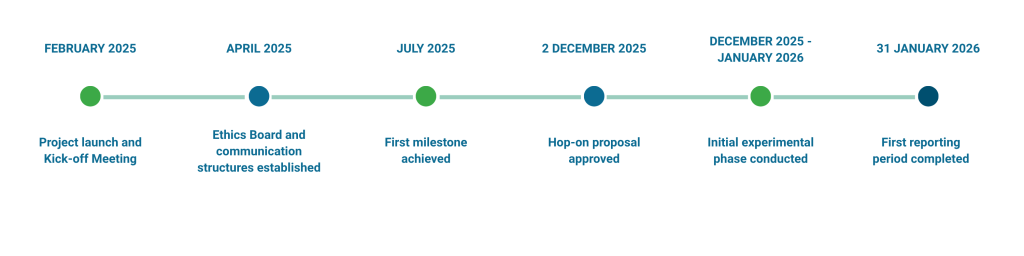
1st Milestone achieved
Defined waste, reactants, products of interest, apparatus and methodology was reached as planned
REFINED
Research direction
Priority materials, target products, and assessment criteria were defined,
achieving key project KPIs.
PREPARED
Experimental framework Experimental, analytical, and monitoring strategies were established, and existing capabilities were adapted.
INITIATED
First research activities Experimental, analytical, modelling, toxicological and sustainability work began, generating the first project data
A MULTI-METHOD EVIDENCE BASE – FULL SAMPLE CHARACTERIZATION
Initial work combined tribological testing, analytical method development, ball-milling reference tests, and preliminary reactive molecular-dynamics studies. Ion chromatography method was developed to support fluoride quantification in challenging sample mixtures, while computational work began informing reaction mechanisms, toxicology, and sustainability assessment.
WHY IT MATTERS
To ensure tribolysis process safety and sustainability, alongside efficiency, comprehensive characterization is necessary, as by-products in gas, liquid or solid phase might jeopardize these process characteristics
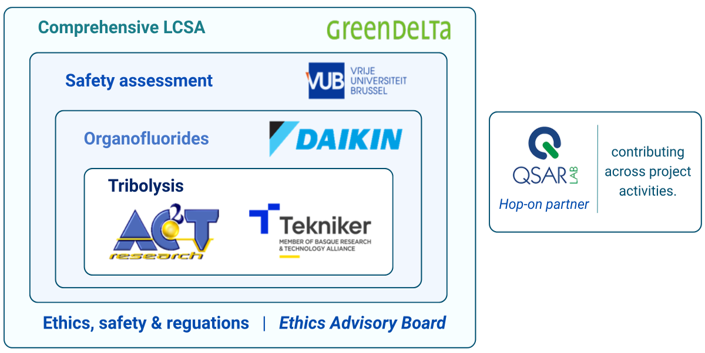
COLLABORATION ACROSS EUROPE
SAFETY AND SUSTAINABILITY BY DESIGN
TriFluorium advances technical feasibility together with safety, sustainability, ethics, data quality and exploitation planning. This parallel approach is intended to identify barriers early, while the technology can still be adapted.

ETHICS OVERSIGHT
Independent three-member Ethics Advisory Board appointed.

RISK MANAGEMENT
Risk-management procedures and Standard Operating Procedures (SOP) established.

SUSTAINABILITY ASSESSMENT
Environmental and social
assessment activities
initiated.

SAFETY ASSESSMENT
Experimental and computational toxicology initiated.
IP-SAFE PUBLIC COMMUNICATION:
Detailed materials, operating conditions, technical configurations, and preliminary findings remain confidential while scientific validation and intellectual-property assessment are ongoing.
COORDINATOR QUOTE
“The first year led to the shared scientific and operational foundation. We can now build on the lessons learned as TriFluorium moves towards stronger experimental evidence and future technology development.”
Lucia Pisarova | Project Coordinator | AC2T research GmbH
LOOKING AHEAD
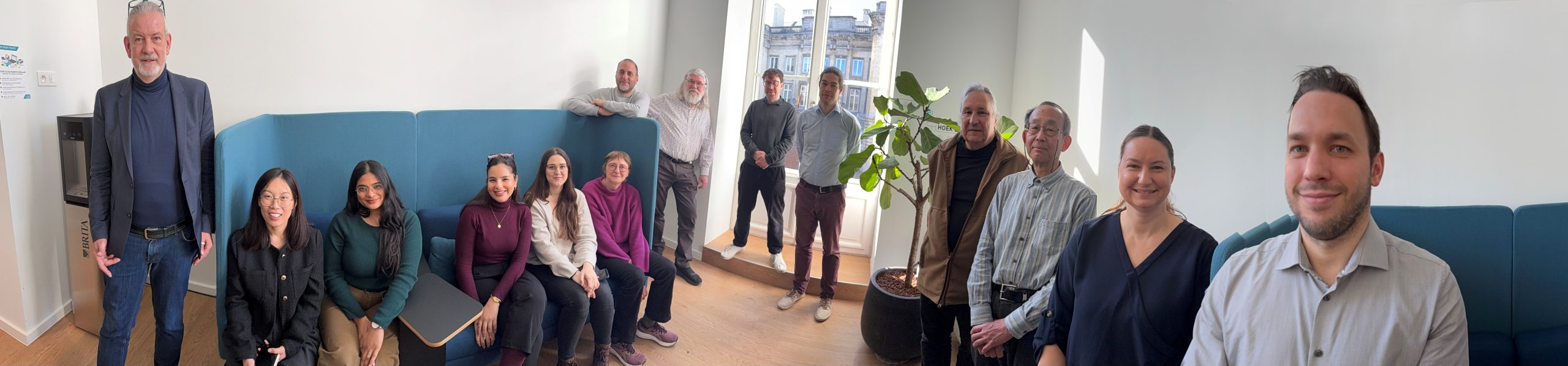
Next Stop: Brussels The First Project Review Meeting
FOLLOW THE TRIFLUORIUM JOURNEY







Funded by the European Union (EU) under the Grant Agreement No. 101187492. Views and opinions expressed are however those of the author(s) only and do not necessarily reflect those of the EU or the European Innovation Council and SMEs Executive Agency (EISMEA). Neither the EU nor the granting authority can be held responsible for them.